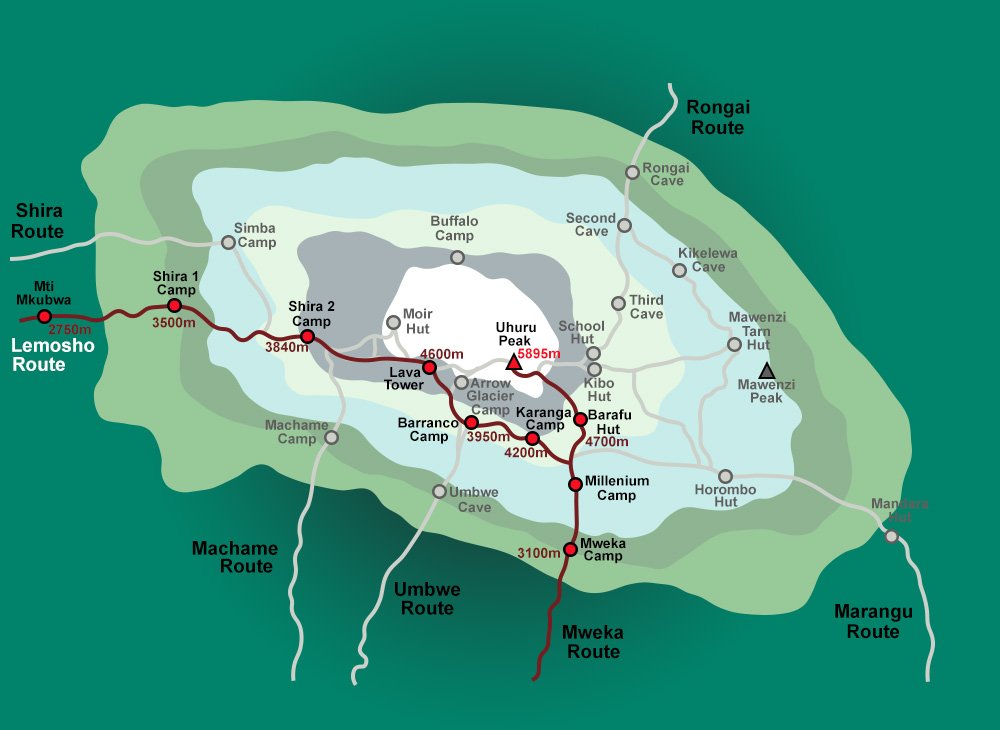
The Marangu Route is the oldest on Kilimanjaro and is also one of the most popular – mainly because it is the only route on the mountain that has huts provided for hikers. This could partly be a result of the fact that the Marangu is the least expensive route, but more so, perhaps the fact that it is possible to do the Marangu route in 5 days, thereby getting to the summit one day earlier. This is not always the best way, due to a shorter acclimatization period, so we recommend taking the Marangu route as 6 days trek.
The Marangu route does however offer you the many options of spending acclimatization day on the mountain. This extends the Marangu route to a 6-day trek greatly increasing your chances of success. However, the success rate with the Marangu route is much lower compared with other Kilimanjaro routes.
Shared hut accommodation on the Marangu route forms one of the main differences, compared to the other routes. It offers you the relative luxury of being able to sleep in huts along the entire route. Mineral water, soft drinks, chocolates, and beers are also sold at all the camps on this route. All your equipment and supplies are portered and a cook prepares all your meals. The main itinerary difference between the Marangu 5-day and 6-day routes is the additional acclimatization day at Horombo Hut. Kibo Huts are always recommended to have at least 1 day in town before starting your trek.
This route is a great choice for those coming during the rainy season (March through June -because let’s face it, camping is no fun in the rain!). Taking this route over 6 days will greatly help you with an extra day of acclimatization.
This route has wonderful views and opportunities of both peaks of Kilimanjaro (Kibo and Mawenzi). It is worthwhile noting that it is the only route of Kilimanjaro where you ascend and descend using the same route.
Tour Highlights
Departure and Return Place: Moshi Town to Marangu Gate and then back to Kilimanjaro International Airport (Google Map)
Departure Time: Please be ready by 8:15 AM for a prompt departure at 9:30 AM.
Return Time: Approximately 10:30 AM on the last day.
Dress Code: Casual. Comfortable athletic clothing, hiking shoes, hat, cold weather jacket, gloves, pants, and spare clothing.
Accommodation: Two nights of accommodations based on Bed and Breakfast at 3 stars hotel (upgrades on request).
Customizations: Can be customized upon request, to meet traveller’s needs
Extensions: Trip Extensions are available on request.
Trip Availability: All year round.
Trip Highlights
Arrival
Day 1: Marangu Gate (1980m) – Mandara Hut (2700m)
Day 2: Mandara Hut (2700m) – Horombo Hut (3720m)
Day 3: Horombo Hut (3720m) – Acclimatization Day
Day 4: Horombo Hut (3720m) – Kibo Hut (4700m)
Day 5: Summit Attempt – Kibo hut (4700m) – Uhuru Peak (5895m) – Horombo Hut (3720m)
Day 6: Horombo Hut (3720m) – Marangu Gate (1980m)
Departure
Itinerary
Arrival Day :
Arrive in Moshi, Kilimanjaro
Arrival at Kilimanjaro International Airport (JRO), where you will meet our representative, and transfer to your hotel in Moshi town. The hotel will provide all the essentials for a classic stay: cozy rooms, hot water, polite staff, a swimming pool, and Internet access. In the evening there will be a briefing with our guides, who will also make sure you are ready to begin the climb.
One Night Hotel Accommodation at Bristol Cottages in Moshi before the hike.
Day 1 :
Marangu Gate (1980m) – Mandara Hut (2700m)
After an early breakfast at your hotel, you will be picked up from Moshi and driven to the Marangu Gate (1980m). At the gate, the porters will organize and pack the belongings for the hike while you and your guide register with the Tanzania National Park (TANAPA). You will then begin your ascent into the rainforest. During this section of the hike, you should expect rain, mud, and fog. Also, be on the lookout for wildlife, including Colobus monkeys! After 3-4 hours of ascending, you will reach the Mandara Hut (2700m). Each hut has 6-8 sleeping bunks (sleeps 60 hikers total) with solar-generated lighting. Next to the central hut, there are flush toilets. The porters, who arrive at the campsite before the clients, will boil water for drinking and washing. The chef will prepare a snack and then dinner for the clients. At nighttime, mountain temperatures may drop to freezing so be prepared!
High Altitude Mountain Camping on Mount Kilimanjaro
Day 2 :
Mandara Hut (2700m) – Horombo Hut (3720m)
Following breakfast, hikers will begin their ascent out of the rainforest and into the heathen moorland. Hikers will pass the Maundi Crater and are able to climb up to its rim for a spectacular view of the Kibo Crater. In the moorland, you will spot exotic plants, including giant lobelia and groundsel. After 6 hours of hiking, you will reach Horombo Hut (3720m). Horombo Hut sleeps 120 hikers and is located on a small plateau. Similar to the first night, the porters will prepare drinking and washing water for you. You will enjoy evening snacks then dinner prepared by our chef. Be prepared for a cold night as temperatures drop below freezing at this site.
Hiking time: 6 hours Distance: Approximately 15 kilometers Habitat: Moorland
High Altitude Mountain Camping on Mount Kilimanjaro
Day 3 :
Horombo Hut (3720m) – Acclimatization Day
At Horombo Hut, you will spend the day allowing your body to acclimate to high altitude. You will have the option of doing a day hike to Mawenzi Hut (4600m) for further acclimatization with your guide. Breakfast and dinner will be at the hut and lunch will either be packed or at the hut depending on your preference for the day.
High Altitude Mountain Camping on Mount Kilimanjaro
Day 4 :
Horombo Hut (3720m) – Kibo Hut (4700m)
Following an early morning breakfast, you will continue your ascent into the alpine desert habitat. Hikers have the option of 2 trails that lead to Kibo Hut (4700m). The upper route (located to the right of the fork) is the same trail used the previous day for the day hike to Mawenzi Hut. The lower route (located to the left of the fork) is the more popular route because it is a shorter hiking distance (1 hour shorter).
Kibo Hut is located in the “Saddle,” which refers to the area located between the peaks of Mawenzi and Kibo in an alpine desert. There is no water at this camp, but hikers can buy mineral water and soft drinks at the camp office. An early dinner will be served so hikers can rest before attempting the summit the same night. Your guide will brief you in detail on how to prepare for summit night. Get to sleep by 19:00!
High Altitude Mountain Camping on Mount Kilimanjaro
Day 5 :
Summit Attempt – Kibo hut (4700m) – Uhuru Peak (5895m) – Horombo Hut (3720m)
Your guide will wake you around 23:30 for tea and biscuits. You will then begin your summit attempt. The trail is rocky up to Hans Meyer Cave (5150m). You continue your ascent to Gillman’s point (5681m). Reaching this section is an impressive achievement as the trail is steep, rocky, and at high altitude. Gillman’s is located on the crater rim. From this point, you will usually experience a snow covered trail until you reach the summit, Uhuru Peak (5895m). Reaching the summit of Mt. Kilimanjaro is a lifetime accomplishment! You will be able to spend a short time on the summit taking photographs and drinking tea before the descent to Barafu begins. The hike down to Kibo Hut takes about 3 hours.
At Kibo Hut, you will rest and enjoy a hot lunch in the sun. After eating, you will continue descending down to Horombo Hut (3720m). You will have a dinner, wash, and rest soundly at the hut after a strenuous day.
Hiking time: 8 hours to Uhuru and 6 hours to Horombo
Distance: Approximately 6 kilometers ascent and 21 kilometers descent
Habitat: Stone scree and ice-capped summit
High Altitude Mountain Camping on Mount Kilimanjaro
Day 6: :
Horombo Hut (3720m) – Marangu Gate (1980m)
Following a well-deserved breakfast, your staff will have a big celebration full of dancing and singing. It is here on the mountain that you will present your tips to the guide, assistant guides, chef(s), and porters. After celebrating, you will descend for 6 hours back to Marangu Gate (1980m). The National Park requires all hikers to sign their names to receive certificates of completion. Hikers who reached Gillman’s Point (5681m) receive green certificates and hikers who reached Uhuru Peak (5895m) receive Kilimanjaro certificates. After receiving the certificates, you will drive back to your hotel in Moshi. Hiking time: 6 hours Distance: Approximately 27 kilometers
Breakfast
Departure :
Rest in the hotel and transfer to the airport.
Note: Hotel check-out is at 11:00 AM. In case you need a late check-out because of an evening flight, there is the option to extend your hotel stay for an extra fee.
Includes/Excludes
Trip Cost Includes
Two way private airport transfers
All park fees collected by the National Park
Hotel ccommodations one night before and one night after the expedition
Tented accommodation on Mount Kilimanjaro
All meals on the hike
All group equipment (dining tent, table, chairs, crockery and cutlery)
Oxygen cylinders and oximeters
Complete Expedition medical kits
Professional guides licensed by Kilimanjaro National Park
Dedicated support crew (assistant guides, camp master, porters, cooks, etc.)
Government taxes
Crew salaries
Medical evacuations with AMREF Flying doctors
Purified water while on the mountain
Portable tented private flush toilet
Trip Cost Excludes
Personal Climbing gears
Tanzania Visa on arrival
Mountaineering Insurance
Tips and Gratuities
Personal Expenses (e.g. laundry, telephone, beverages, etc.)
Costs
Number of People
Cost Per Person in US($) Standard Package
1 Person
$ 2,350
2 people
$ 2,050
3 people
$ 2,000
4 people
$ 1,980
5 people
$ 1,960
6 people
$ 1,940
7 people
$ 1,920
8 people
$ 1,900
9 people
$ 1,880
10 People +
$ 1,860
When is the best time to climb Kilimanjaro?
Mount Kilimanjaro can be climbed anytime throughout the year. Most travelers prefer climbing during the dry seasons: December to March, June to October. Many consider the best months to climb Kilimanjaro to be January, February, and September.
Who are your operators in Tanzania?
We are. We are not agents for anybody, but run the treks ourselves through our own Tanzanian company. So you can rest assured that whoever you speak to in our company has climbed Kilimanjaro – and probably many times.
How long is the hike?
There are at least six routes to the top, Uhuru peak. You will hike between 53 and 73km depending on which route you choose. The shortest and toughest is the 5-day Umbwe route. Allowing extra days will help you to acclimatize better and improve your chances of reaching the summit. The easiest and most popular route is Marangu (which can be done in five), but we use six days for this route.
What kind of experience do I need?
None, but previous hiking or climbing experience will help. You need to be fit and healthy and have a good pair of worn-in hiking boots. The fitter you are the more you are likely to enjoy it.
Do you offer private and fully customizable climbs for Kilimanjaro
Your Kilimanjaro dream climb is entirely your own to design. We will work with you to customize exactly the triumphant Tanzanian mountainous quest experience you want. You go with the people you choose. You leave on whatever day you wish. You decide on your preferred route option, pace, and the number of days you will take.
How many hours will I trek each day?
On most routes, you’ll trek 4-7 hours most days. On certain routes you’ll trek as many as 10-15 hours on the longest days.
Will I see wildlife?
Prior to the climb, you’ll enjoy an acclimatization day with wildlife viewing and nature walks. Trekking through the rain forest, you’re likely to spot black-and-white Colobus monkeys, tropical birds and more.
What kind of food will I eat?
Highly-trained chefs prepare three hot nutritious meals daily, as well as trail snacks and afternoon tea each day. You’ll eat all your meals in a solar-lit dining tent with your fellow trekkers and head guide. Delicious vegetarian, vegan, gluten-free and other specialty meals can be provided (with advance request). We’re happy to send you a sample menu—just ask!
What are the Kilimanjaro accommodations like?
Your mountain camps are set up and broken down each day by expert camp porters. You’ll stay in double occupancy all-weather tents with full-ground pads to keep you and your gear dry. Private toilet tents, solar-lit dining tents with tables and chairs, and basins of hot water for washing are provided in every camp. Grand Traverse treks include upgraded solar-lit walk-in-height sleeping tents with mountaineering beds and mattresses for additional comfort.
Who are your operators in Tanzania?
We are. We are not agents for anybody, but run the treks ourselves through our own registered Tanzanian local company.
Do you arrange airport pick up & Drop off?
Yes, we do arrange this. Please send your request to Safari.
What travel documents do I need?
You will need a passport that is valid at least six months beyond your dates of travel with an entry or re-entry visa, duly endorsed.
Where is Kilimanjaro?
The mountain is in Tanzania, East Africa, about 350km from the equator. The nearest towns are Moshi and Arusha.
How high is Kilimanjaro?
Mount Kilimanjaro is the highest freestanding mountain in the world and the highest mountain in Africa. Its highest point is Uhuru Peak on the Kibo crater at 5895m above sea level.
Do we tip the hiking crew?
Yes, it is expected and much appreciated. The amount depends on the number of days, but can range from $150 and $350 per hiker. Tips are pooled and shared amongst the crew.
Explore the stunning East African landscapes and diverse wildlife while cycling around the largest freestanding volcano globally, offering immersive experiences with the local culture and...
The Northern Circuit route is one of the best routes on Kilimanjaro, offering nearly 360 degrees of beautiful scenery, including the quiet, rarely visited northern slopes....
The Lemosho route is very scenic as you pass through the west Kilimanjaro captivating local farms area. You pass through forest vegetation toward the park's...